
Most people who call us about a patio cover have already decided on aluminum. What they haven't decided is the roof. That's the part that sets how hot the patio gets at 3 in the afternoon, and whether the family room behind the slider goes dim once the cover is up.
Here's how we talk it through with homeowners in Los Angeles and San Diego.
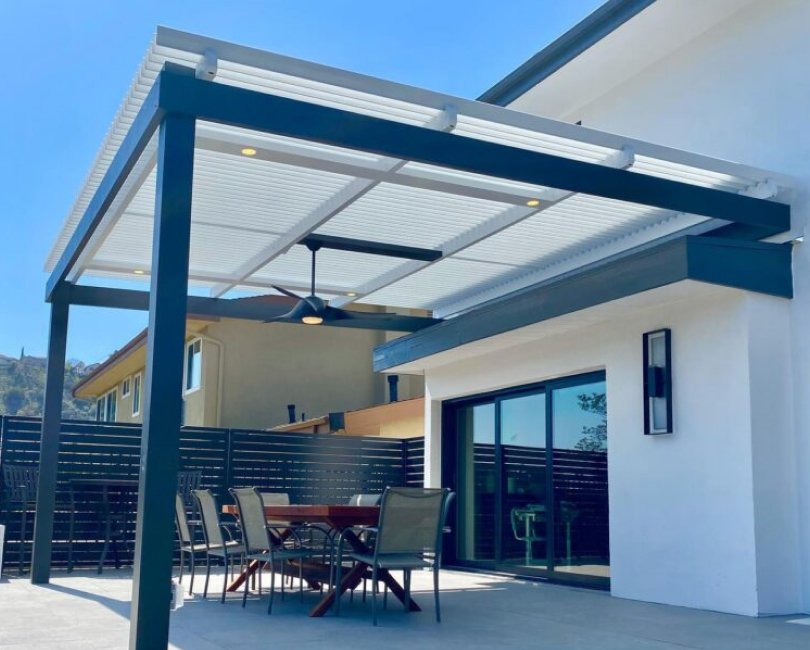
Solid roof, translucent panels or an open trellis
Solid aluminum or metal. If you want shade every day and a roof that doesn't change, this is it. It also means all the rain lands on it, so we plan the slope, the edges and any gutters to send water away from doors, chairs and the path people walk.
Translucent panels in a metal frame. It's still a fixed roof, but light comes through. This is the one we point people to when a solid roof would leave the kitchen or family room darker than they'd like.
An open 4K aluminum trellis. Here the members stay open. You get broken-up shade and you still see sky. How far apart the members sit and which way they run changes how much sun reaches the patio, so that gets set with you. If you want more shade later, the frame can take fabric panels or a slide-on-wire canopy. Our crew assembles 4K on site, which shortens the bigger builds.
Some people want sun in winter and shade in summer. For them, a retractable awning or a slide-on-wire canopy can make more sense than a fixed roof, as long as the site and structure can take it.
Attached to the house or freestanding
An attached cover carries the line of the house out over the patio, with posts at the outer edge where they're needed. Before we go that way, we look at the wall, the roofline and eaves, the doors and windows, the waterproofing and where the cover can actually connect.
A freestanding cover sits on its own posts. It's a good fit by a pool deck or in a courtyard, where you want a separate outdoor room. Plenty of covers end up part attached and part on posts.
Where the posts go matters more than people expect
A post in the wrong spot is something you'll walk around for years. So before we size anything, we look at where the table, grill and chairs sit, how people get from the door to the yard, and where the rain will run. The cover shouldn't block a door, crowd a window or dump runoff on the walkway.
The underside matters too, since that's the part you actually look at. If you want lights, a fan or a heater, tell us at the start. They get planned into the cover instead of tacked on after it's built.
Valley heat or coastal air
A patio in Chatsworth and one in Santa Monica get very different weather. Inland, the cover is up against hard afternoon sun and heat. Near the coast it's damp mornings and salt air. Santa Ana winds hit both. We pick the frame, the panels and how the cover ties into the house with your location in mind.
Permits
There's no blanket answer here. It depends on your address, the size of the cover and how it attaches. In the City of Los Angeles, the Community Plan, zoning, the building code and the attachment all factor into the review. Cities like Beverly Hills and Burbank run their own. In San Diego, Development Services handles zoning and building review, and coastal, historic and planned-district properties can have extra requirements. If you're in an HOA, its rules apply on top of the city's. We confirm what your property needs before anything is ordered.
Questions we get a lot
Should I get a solid roof or an open trellis?
It comes down to how much sky you want to keep. Solid gives steady shade and handles the rain. An open trellis filters the sun and keeps the patio feeling open. Translucent panels sit in between, with a fixed roof that still lets daylight through.
Can an aluminum patio cover attach to my house?
Yes. It can attach to the house, stand on its own posts, or do a bit of both. The structure, the span and the site decide which one works.
Do I need a permit for a patio cover?
Often, but it depends on the address, the size of the cover and how it attaches. We check it for your property during the estimate.
Can I have lights and a ceiling fan under it?
Plan them from the start. We work out lights, fans and heaters along with the slope and drainage, so they fit the cover instead of getting squeezed in later.
Getting an estimate
The easiest way to start is to send us the address, a few photos of the patio, a rough size and height, how much shade you're after, and whether you want a fixed or adjustable cover. If you have plans, include them.
We design and fabricate covers at our shop at 7053 Canby Ave. in Reseda, and our own team installs it. You can see more of our work on the Los Angeles, San Diego and Orange County patio cover pages and the 4K aluminum trellis page. When you're ready, send us your patio details for a free estimate, or call (818) 882-0027 on weekdays.